

6 Books by Asian Authors to Decolonize Your Bookshelf
From grief memoirs to speculative fiction, these six books by Asian authors illuminate identity, belonging, and resilience. Start your list here.

Periphery is a publication dedicated to fostering greater understanding and appreciation of Asian cultures and experiences among a global readership. Subscribe to decolonize your reading and discover unique writing.

Welcome or welcome back to Periphery. A special welcome to Suchita Senthil Kumar who writes Self Portrait, and Samantha Lee, who writes Acts of Service. Please take a moment to check out their work and welcome them to our community! If you’d like to be added to the directory, please fill out this form.
Today, I’m sharing some books I read in recent years that I hope will pique your interest.
Nonfiction
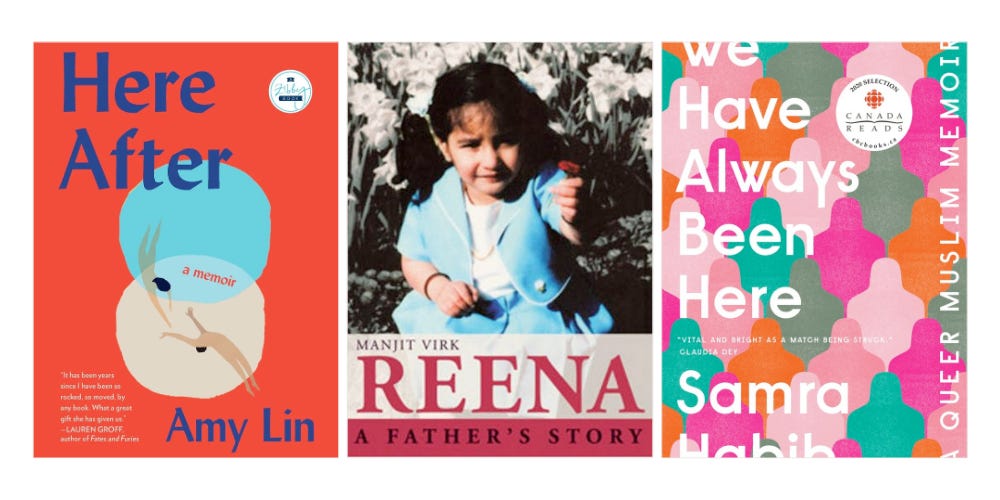
Here After (Amy Lin, 2024). This was not an easy read. I didn't expect it to be. Amy's memoir of her first year after her husband's sudden and unexpected death at only 32 years old is heartbreaking and raw. Her language is sparse yet striking; the chapters are very short, yet impactful. Still, it's not a book meant to be read quickly. Amy's description of grief and the lies we've been told about it, her attempts to convince her family and friends she's okay, were all too familiar to me. A necessary book for everyone, because grief will visit us all someday.
Reena: A Father's Story (Manjit Virk, 2011). If you're familiar with Reena Virk's story, you'll know this will be a difficult read. Reena Virk was 14 years old when she was murdered in 1997 by a group of her peers she'd been bullied by. All she wanted was to have friends, to belong. Her father, Manjit, wrote this book as a way to cope with his grief--a motivation I relate to--and shares their family's story. He writes of Reena's struggles to fit in as part of a minority group in Canada, the poor choices she made as a result of her desperation that harmed herself and her family. Manjit and his wife, Suman, faced racism from Canada's Ministry of Children and Families as they fought to protect their child. This book is a sobering look at how the system failed a family, leading to the senseless murder of a 14-year-old girl. Amidst these horrifying events, Manjit and Suman's strength and faith, refusal to stay silent about the injustices their family suffered, are truly admirable.
We Have Always Been Here (Samra Habib, 2019). I came across this book by complete accident, and I’m so grateful I did. Samra’s story of growing up in Pakistan, immigrating to Canada, and discovering their identity as queer, is an essential read for everyone. Theirs is an incredible journey of repression to freedom, of finding one’s voice in a world that says they shouldn’t exist. I recommend this to anyone who has felt like they don’t belong, and needs some hope (aka everyone).
Fiction
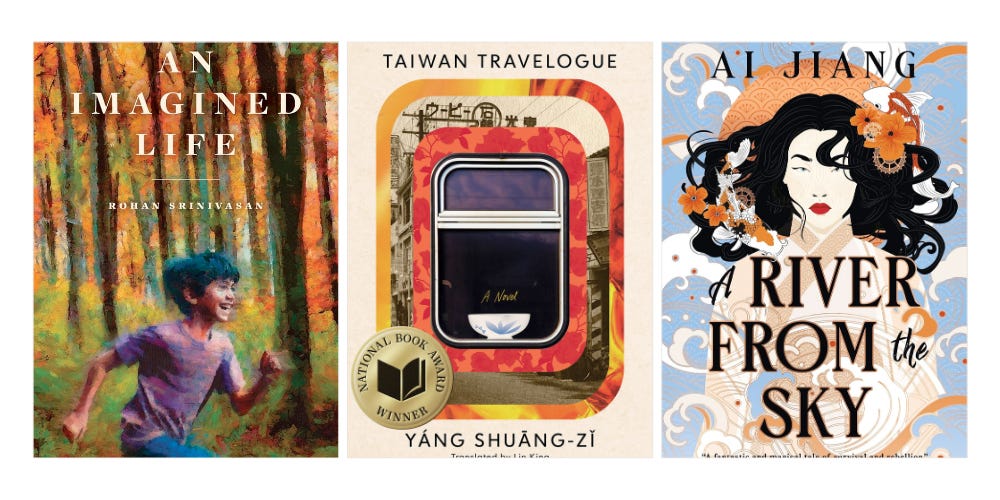
An Imagined Life (Rohan Srinivasan, 2024). A stunning debut about a young boy whose world gets turned inside out after a family tragedy. Akash has always lived in a close-knit community, but when circumstances force him and his mother to move across the country, he finds himself drifting in an unfamiliar world. He finds solace in a mysterious ability to transport himself back into past memories. It's a multi-layered deep dive into what grief is like for a child still growing up and learning about the world, what it's like to be an outsider, and what it means to have deep roots untouched by frost. This is a story that will stay with you and move you, long after you read the last word. Read my interview with Rohan here.
Taiwan Travelogue (Yang Shuang-Zi, 2020). The most compelling aspect of this novel is that it's presented as a rediscovered translated nonfiction travel memoir by a young Japanese writer who traveled to colonised Taiwan in 1938. This is one of those slow, subtle books that you have to take time getting to know. It covers multiple layers of colonialism, identity, history, and friendship. Once you sit with it, though, it's well worth it. I wrote a full review here.
A River from the Sky (Ai Jiang, 2026). As usual, Ai Jiang delivers a beautifully written book with multiple layers that I want to read over and over. Although this is a short novella, there is so much going on. I really enjoyed diving into Lufeng's sister's POV more in this book. I found her really interesting, especially as she wrestled with how to save her people and home without losing herself and becoming like those she's fighting. These are questions we must ask ourselves all the time when we engage in social justice. Ultimately, I always wish I could spend more time in Ai's worlds. She has such a rich imagination and describes them with such lyrical beauty. A bittersweet conclusion to the Natural Engines duology. Read my interview with Ai here.

Have you read any of these or do you intend to? What did you think?
Thank you, Young Woong Yi, Andrea Louie, Bill Bishop, Demian Yumei, TheUltraContemplative, sunshine moonlight, Lael Johnson, Sanobar Sabah, for your generous support.
Want to write for us?
Featured writer — Submissions are open on a rolling basis with no theme. Even if you’ve submitted previously, I encourage you to do so again, because I’m now opening it to writing pieces that have been previously published on personal blogs or Substacks. Full guidelines can be found on this page. Payment: $10 upon publication.
Curator — no limit: Sign up to curate one of the monthly round-ups. There are different ways to do this. You can either look through the Periphery directory and read posts you want to highlight, or highlight posts by Asian authors you already subscribe to. This page has our past editions if you need a reference. Sign up for an upcoming month here. Open to Periphery members.
Decolonise Your Bookshelf series — no limit: If you love books and also love recommending them to others, sign up to write one of these posts. This is one of my favourite things to do and would love to hear about more books by Asian authors from y’all. Check out this page for past issues. Open to everyone.
To keep this work sustainable, please upgrade your subscription or give a one-time donation. This is incredibly important so I’m able continue this work. Financial support directly impacts how much time I’m able to devote to this publication. Thank you!